

10.11.2025
ZeroAvia and Hybrid Air Vehicles sign agreement to collaborate on zero-emission Airlander
- Companies will explore equipping Airlander aircraft with four ZeroAvia hydrogen-electric ZA600 powertrains
- With plenty of room for hydrogen storage in the hull, the hydrogen-electric Airlander will have unparalleled range and capacity for an electric aircraft
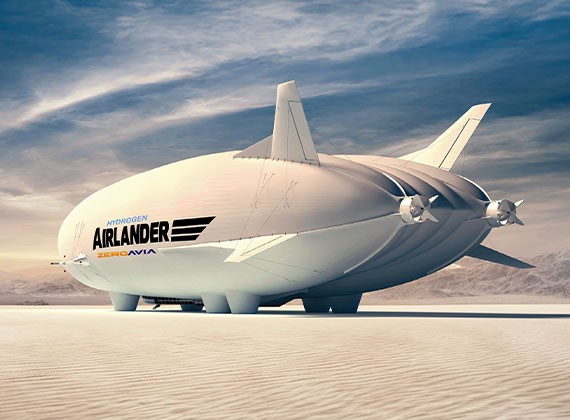
ZeroAvia and Hybrid Air Vehicles today announced that they have signed a Memorandum of Understanding to partner on development of a hydrogen-electric variant of Airlander 10.
Airlander 10 is a new type of hybrid aircraft that uses a combination of aerostatic lift, aerodynamic lift, and vectored thrust, with a 10 tonne payload and 4,000 nautical mile maximum range. The initial Airlander 10 will be powered by four diesel engines, providing an emissions reduction of up to 90% when compared with comparable capacity aircraft. Integrating ZeroAvia’s hydrogen-electric propulsion will deliver full zero-emission in-flight operations carrying 100+ passengers, as well as reduced maintenance costs.
ZeroAvia’s first generation 600kW hydrogen-electric powertrain – ZA600 – has already passed several regulatory milestones, secured hundreds of pre-orders and signed up launch customer airlines who are working to embed the system into more traditional fixed-wing aircraft for lower cost and more environmentally friendly flight. The company has conducted flight testing of a prototype on board a 19-seat aircraft.
With ample space for hydrogen storage in the hull, the Airlander represents an excellent option for adopting the first generation of certified hydrogen technologies that are already close to market entry: hydrogen storage, low temperature PEM fuel cell power generation and electric propulsion systems that are well advanced in the certification journey. This partnership will build on HAV’s earlier R&D work to explore electric propulsion for Airlander.
As part of the agreement, the companies will also study the potential applicability of ZeroAvia’s hydrogen-electric technology to future larger aircraft developed by Hybrid Air Vehicles, and assess planned Airlander 10 operations to define the hydrogen fuel infrastructure requirements.