

09.04.2026
As an island nation, many of the UK’s most important domestic air routes are not simply regional links across land, but connections across water.
Analysis of travel patterns following the pandemic found around 37% of UK domestic passengers were travelling to or from Northern Ireland, with a further 13% flying between the mainland and the Channel Islands. A substantial share of domestic aviation exists to maintain essential connectivity where surface alternatives are limited or impractical.
Fast forward to today, and the recovery in domestic aviation is clear. In the year ending March 2025, around 19 million passenger journeys were made on domestic flights across Great Britain. This scale of travel reflects more than convenience. For many journeys across the Irish Sea and to island communities, flying remains the most practical option, while ferries provide an alternative that is reliable but significantly slower. At the same time, many of these routes are short in distance but emissions-intensive, creating a growing challenge as the UK works toward its net-zero commitments. (Did you know that aircraft on routes of 700 km or less emit more carbon dioxide per person for every km travelled than long-haul flights? 251 g/km for short haul compared to 195 g/km for long haul.)
Crossing the Irish Sea
Hybrid aircraft, like Airlander, introduce a new option for regional travel, combining reduced emissions with the ability to operate closer to where passengers tend to start and end their journeys.
Taking the example of a journey from Liverpool city centre to Belfast city centre, a comparison of total journey time and emissions illustrates the potential role of this new type of aircraft:
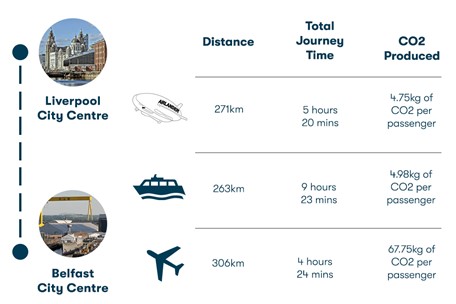
Compared with ferry travel, Airlander could reduce total journey time by around four hours while producing a similar level of emissions.
Compared with a conventional aircraft, Airlander’s carbon intensity is around 7% of the emissions per passenger, while offering a broadly comparable door-to-door journey time.
Complementing the existing network
The future of UK domestic travel will not be defined by a single mode of transport. Traditional aeroplanes will continue to play a critical role in high-demand and time-sensitive routes. Ferries will remain essential for moving vehicles or large amounts of freight.
However, the data shows that many domestic journeys sit between these two models: routes where distances are moderate, demand is steady, and the overall travel experience matters as much as airborne flight time.
Airlander is designed to operate within this space. Its ability to operate from reduced infrastructure and closer to urban or regional centres creates new opportunities to improve connectivity without the need for major airport expansion.
Rather than replacing existing services, hybrid aircraft offer an additional layer within the transport network. Increasing choice, improving resilience, and supporting ultra-low emission travel.
Supporting connectivity in a net-zero future
The pattern of domestic flying shows that connectivity across water is not a niche requirement, but a core part of the national transport system.
As the UK moves toward its decarbonisation goals, the challenge will be to maintain these essential connections while reducing their environmental impact.
For routes where geography limits surface alternatives and where conventional aviation carries a high emissions cost, Airlander offers a practical new way to travel. Helping the UK stay connected while moving toward a more sustainable future.