

02.03.2026
Airlander 10 will be our first aircraft to market – a 98m long aircraft that will be able to carry 10 tonnes or 100+ passengers. You are going to see this aircraft moving people over regional routes, carrying tourism passengers on overnight expeditions, or used in the defence world as a long endurance surveillance platform. What happens next is just as exciting…
Lighter-than-air technology is unique in its scalability. Airlander only needs to get a bit bigger to be able to carry significantly more payload – the efficiency scales with size. What does this mean? Well, it means that larger Airlander variants will become even more efficient at carrying payload, further reducing cost per tonne km or cost per passenger km.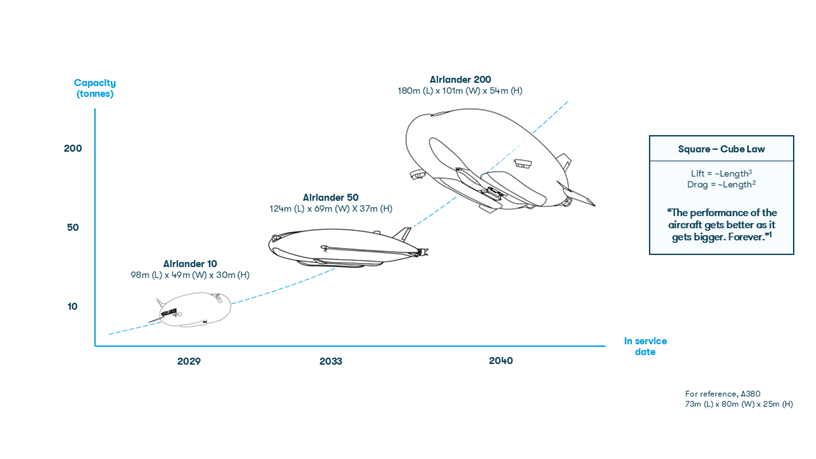
Because Airlander’s lift comes from both buoyancy and aerodynamic shaping, Airlander’s payload capacity increases faster than its size: small increases in dimensions unlock substantial gains in useful load while reducing cost per kilogramme of payload carried.
The core markets for future larger Airlander variants are logistics and freight, including mainstream logistics, remote logistics, and outsize loads. Large industrial components, renewable energy projects, and oversized cargo are increasingly challenging conventional transport systems. Moving heavier loads efficiently is becoming critical, yet traditional freight systems often struggle to scale to meet this demand.
Airlander represents a new category of transport, purpose-built to address these gaps. Not by mimicking existing aircraft or freighters, but by rethinking how lift, payload, and scalability work together in a single platform.
Example: Moving wind turbine blades
For example, Airlander can deliver wind turbine blades directly and efficiently to the construction site. Transporting wind turbine blades is challenging: 50–80 metre blades mean transporting them by road requires meticulous planning. Road or sea delivery typically requires specialist vehicles, police escorts, temporary road modifications, and multiple handling steps, all of which increase cost, complexity, and risk. Airlander’s ability to carry these blades in a direct flight would remove these bottlenecks and shorten delivery times.
A solution for current logistics challenges
Airlander’s design supports significantly larger loads than conventional freight aircraft, with a family of planned future variants capable of moving heavy, commercial-scale cargo efficiently:
- Heavy‑lift capacity: Larger Airlander variants are designed for carrying 50 - 200+ tonnes. An Airlander 50, for example, would be able to carry six 20‑foot ISO containers.
- Flexible load arrangements: The payload module isn’t limited to standard freight. It can be used for mixed cargo, bulky modules, or specialised freight without complex break-bulk procedures.
- Extended reach: Future larger Airlander variants will be capable of transoceanic delivery, transporting significant payloads with reduced environmental impact.
This combination of size, volume, and range allows logistics operations to scale efficiently, bridging the gap between fast but payload-limited air freight and slower surface options.
Built for industry needs
Airlander’s appeal isn’t theoretical. The logistics sector is exploring use cases: industry leaders like Kuehne+Nagel and disaster‑response organisations are engaging with us through the Airlander Futures Network to help shape how future heavy‑lift variants should be specified for freight applications.
This reflects a broader shift: logistics today demands not just speed or capacity, but versatility, resilience, strong cost performance, reduced environmental impact, and the ability to adapt to growing operational requirements.
Interested in the future of logistics? We would love to hear from you. Enquire about the Airlander Futures Network here.