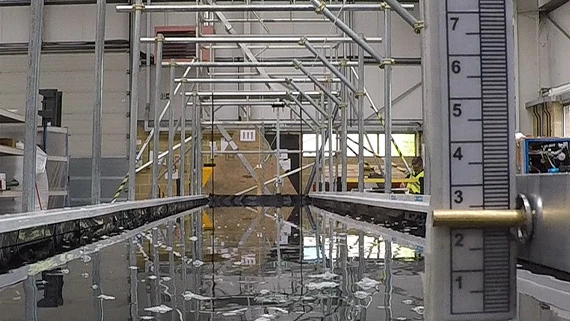
One of the key commercial advantages of the Airlander aircraft is its ability to operate from water. HAV is developing this amphibious capability and optimising the design of the associated skid landing gear with model testing in a water tank. There are a number of specialised water test facilities available worldwide, but they are expensive and require long lead times. Consequently, we have built our own water tank to undertake preliminary work and refine the design of the Airlander landing gear with in-house testing.
The water tank build and test programme is the result of a collaborative effort of the Team at the Airlander Technology Centre (ATC) and several engineering departments including Program Management, Production Planning, Concept Design and Flight Sciences. The test setup at ATC uses simple but effective instruments and methods that result in good quality data at minimal expense and complexity of set-up.
The term “heaviness” is used instead of "weight" or "mass" in this context because the entire aircraft will be mostly supported by helium and the difference between the total aircraft mass and the buoyancy of the helium is the “heaviness”.
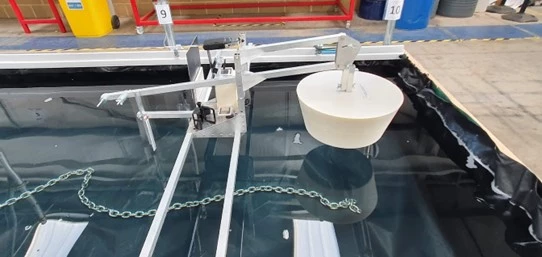
The conical shaped model, shown in the figure (above), represents a single aircraft landing skid, mounted on a tow trolley that runs on rails mounted along both sides of the water tank. Each Airlander will have 6 such skid units; one positioned on either side of the cockpit and two tandem pairs underneath the centre of the aircraft.
So far, a number of different solid skid models have been tested, including flat-bottomed, rounded and faceted shapes. In addition, one of the models is an inflatable shape that is run at scale-equivalent pressure to reproduce the efficient shock-absorbing characteristics of the full-size Airlander landing gear.
When the tow trolley is pulled at a speed down the length of the water tank, four components of longitudinal force act on the skid shape, together with heaviness, buoyancy (hydrostatic lift) and hydrodynamic lift forces in the vertical direction. These various forces need to be separated to maximise the information obtained from the test. The longitudinal forces are the friction in the drop weight mechanism used to pull the trolley, the friction of the trolley wheels, the aerodynamic drag of all the parts moving above the water and the hydrodynamic drag of the skid in the water. The variation in the latter force with tow speed is the main interest of the test.
The effect of friction in the drop weight mechanism is eliminated by using a set of hanging weighing scales to measure the tow line tension directly where it attaches to the tow trolley. The combined effect of trolley wheel friction and aerodynamic drag is isolated by performing a series of “dry” runs at different speeds with the skid shape suspended clear of the water. Subtracting the resulting force variation from the recorded tow line tension then gives us the hydrodynamic drag of the skid as it accelerates along the length of the water tank.
The heaviness of the skid shape is supported by the combination of buoyant and hydrodynamic (aquaplaning) lift , but the relative contributions of these two forces change with tow speed and the height at which the skid shape rides in the water. The latter parameter is indicated by a graduated scale on the towing mechanism and recorded by a dedicated video camera.
Tests have been performed with the skid models ballasted to different heaviness values, covering the range from a lightweight landing through to an overweight take-off.
Some of the tested skid shapes exhibited excellent planing characteristics, combining substantial hydrodynamic lift with low drag. This performance was achieved with minimal volume immersion and the observed behaviour was stable across the range of incidence angles needed to facilitate aircraft take-off and landing on water (see images below).

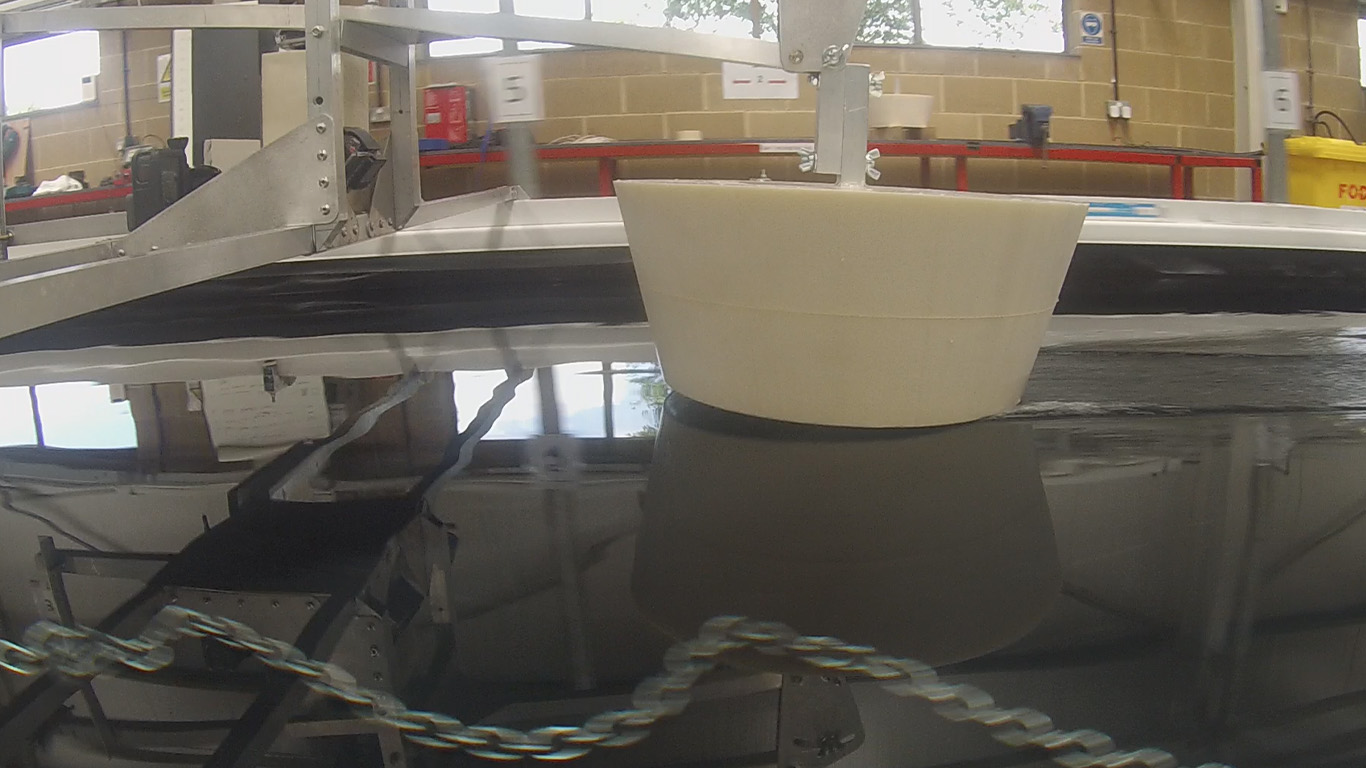
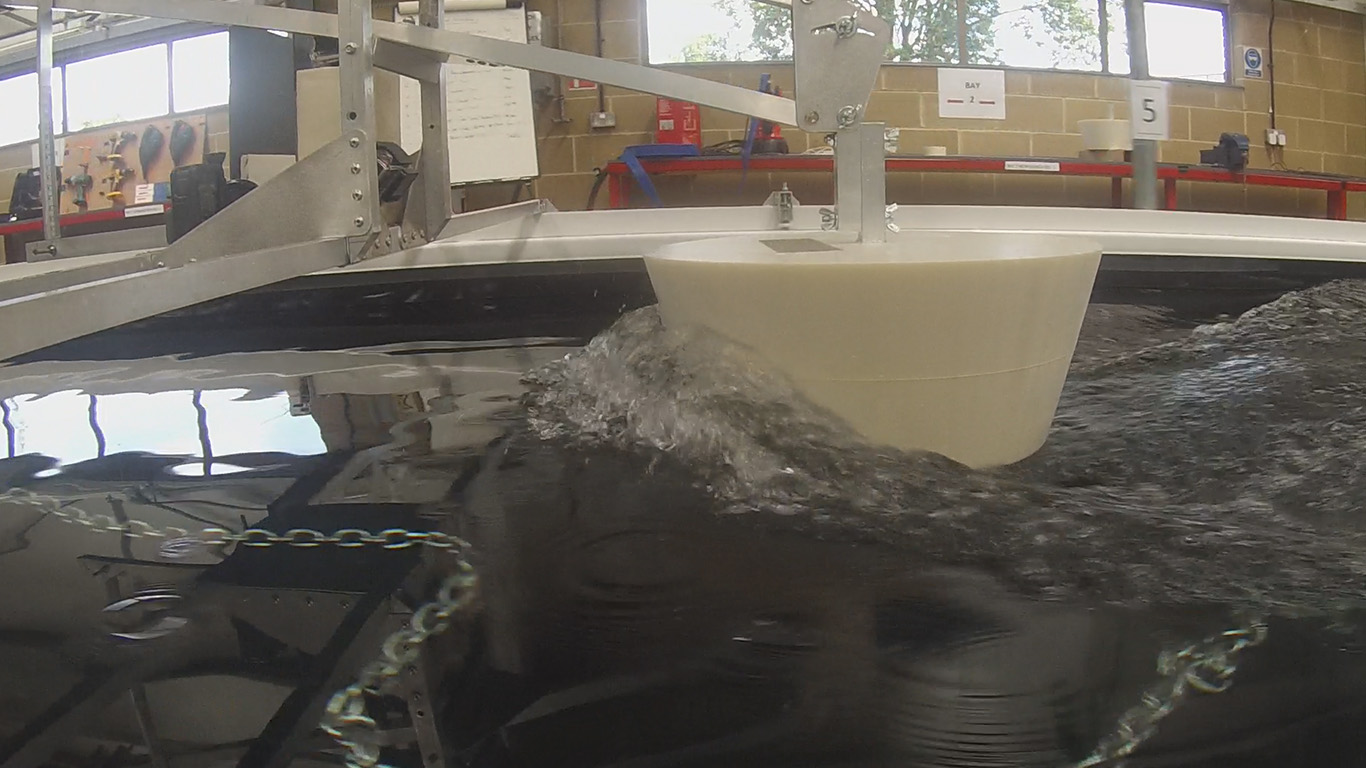
If the incidence or shape is not optimal for planning, then the skid shape burrows into the water with increasing speed, producing a exponential increase in hydrodynamic drag and (in the worst cases) a net suction force into the water that will prevent the Airlander aircraft from taking off (see right hand figure).
The HAV water tow tank will continue to be used in an ongoing programme of development work, leading to definitive testing of the fully optimised Airlander landing gear design in an external specialist hydrodynamic test facility.

