

28.09.2026
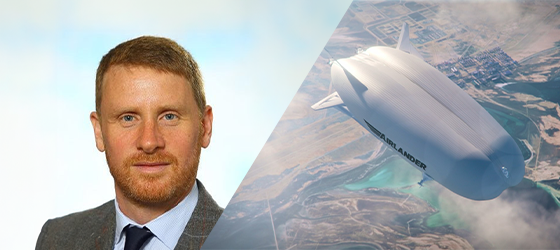
Michael Harper has joined HAV as our new Defence Sales Manager. With a career spanning engineering, business development and emerging technologies, Michael brings more than 25 years of experience in developing international markets for innovative capabilities. In this Q&A, he discusses the defence and security opportunities for Airlander and what he is looking forward to working on at HAV.
Tell us a bit about yourself.
I have over 25 years of experience working across engineering and business development roles at the cutting edge of technology. I've spent time working within defence, energy and agriculture, helping bring innovative products and services to market while developing new business models in complex international environments.
I spent much of my career at Lockheed Martin, progressing from technical and engineering roles into strategy and business development. I have also led strategy and partnerships at Re-Genus, supporting the development of opportunities in regenerative agriculture.
A significant part of my career has involved assessing emerging markets, engaging with governments, industry and wider stakeholders, and helping organisations understand the value that new technologies can bring. What attracted me to Hybrid Air Vehicles was the opportunity to do exactly that with a capability that has the potential to fundamentally change how people think about mobility, logistics and persistence.
What is your role at Hybrid Air Vehicles?
My role is to identify defence and security capability gaps that Airlander can address and work with customers to shape requirements, concepts and investment priorities around those opportunities.
I lead Airlander's defence and security go-to-market strategy across international markets outside the US, developing customer engagement plans, capture strategies and partnerships that position Airlander for long-term success. I also work closely with HAV USA to ensure opportunities are pursued through the organisation best placed to support the customer.
Ultimately, my job is to connect Airlander's capabilities with real operational needs and help turn interest into opportunities.
What roles and markets do you see as early adopters of Airlander in the defence space?
The opportunities for Airlander are incredibly broad, but early adopters are likely to be those organisations with a clear operational need and the willingness to invest in a different way of solving a problem.
I see strong potential in regions such as the Arctic, the Mediterranean, the Arabian Gulf and the Indo-Pacific, where security challenges span huge geographical areas and demand persistent presence. National border security is another area where Airlander's capabilities are particularly relevant.
From a mission perspective, search and rescue, maritime surveillance, airborne early warning, integrated air and missile defence, and freight and supply transport are all areas crying out for greater persistence in challenging operating environments.
What makes Airlander especially compelling is that it can support multiple missions from a common platform, giving customers the flexibility to meet a range of operational needs without increasing fleet complexity.
What do you think makes Airlander stand out compared to the aircraft and platforms you've worked with before?
Airlander stands out because it fills real defence and security capability gaps with a value proposition that extends far beyond the platform itself.
Its technical capabilities are clearly differentiated, particularly in terms of endurance, payload flexibility and minimal infrastructure requirements. But the real story is broader than that.
Airlander delivers benefits across the technical, economic, social, industrial and environmental domains. It has the potential to provide greater persistence at lower operating cost, support sovereign industrial growth, improve access to remote locations and significantly reduce environmental impact compared with many conventional alternatives.
For me, that's what makes Airlander so interesting. It's not simply a new aircraft competing with existing aircraft. It's a different way of solving long-standing operational challenges.
What are you most looking forward to working on in the next 12 months?
I'm looking forward to focusing our efforts and continuing to refine our understanding of where Airlander can deliver the greatest impact.
That means working closely with customers and stakeholders to sharpen our value propositions, better define the capability gaps we address and build a strong pipeline of meaningful opportunities.
The challenge, and the opportunity, is finding the right balance between what is attractive to the market and what is right for the business as HAV scales into production and expands internationally. Getting that balance right will be critical to building sustainable growth and ensuring Airlander delivers on its considerable potential.